
Which ‘Stuck’ Pattern Is Running Your Life Right Now?
You know that draft you've rewritten four times and still haven't sent. Or the yes you gave on Tuesday when every part of you meant no. Or the compliment you waved off before it even finished landing.
Every one of those is a clue pointing to the same stuck pattern. And by the end of this post, you're going to know exactly which one it is.
This week's post comes with a video too — because some things are easier to say out loud.
None of this happens because something is wrong with you. Somewhere back down the line, one of these patterns kept you safe. It did its job so well that it's still running, mostly without your permission, years after the danger passed.
If you're somewhere in the middle of all this and not sure which stage you're actually in, our free reflection, Where Are You In Your Becoming?, was made for exactly this. Eight questions, about two minutes, no wrong answers. It'll name your stage plainly and hand you a reading path to match.
Five Stuck Patterns, One Flinch
The video walks through these fast, five scenes, five flinches. Here's the deeper version, what's actually underneath each one.
The People-Pleaser
She says yes before she's finished hearing the question. On the surface, that looks like generosity. Underneath, it's usually a much older skill: reading a room and keeping the peace in it, learned back when that was how she stayed safe or stayed loved. The tell isn't the yes itself, it's the version of no she rehearses in her head all day and never actually says out loud.
The Perfectionist
The draft stays in the folder, still labeled “final.” It looks like high standards, and she'll call it that herself. But the fear underneath isn't really about quality, it's about being seen and then judged for what's seen. She'll spend three hours polishing a slide nobody will remember, and call it attention to detail, because that story is a lot more comfortable than the real one.
The Doubter
The compliment gets deflected before it lands. Underneath that reflex is a quieter belief: that being seen as capable puts her on the hook for staying capable forever, so it feels safer to wave it off than to actually own it. It shows up other places too, over-explaining an opinion in a meeting, qualifying a good idea into a question before anyone can shoot it down first.
The Waiter
She calls it research, or patience, or just not being ready yet. Underneath, it's a stalling tactic dressed up as wisdom, waiting for a guarantee before risking disappointment. The “right time” keeps moving specifically so she never has to find out whether she could survive it going wrong.
The Rescuer
She's the most reliable person in every room she's in. Underneath, over-functioning is often a way of staying needed, because being needed has felt safer than being wanted for herself. She's usually the first to notice everyone else is exhausted, and the last to notice she is too.
Whichever one you just recognized yourself in, that's not a character flaw. It's a strategy that worked once. If you want a written, one-line counter-move for each of these to actually start with, that's exactly what 5 Hidden Patterns Keeping You Stuck was built for.
If you want the full picture on all five, including one small counter-move for each, that's exactly what 5 Hidden Patterns Keeping You Stuck was built for. It's the free guide for this whole series.
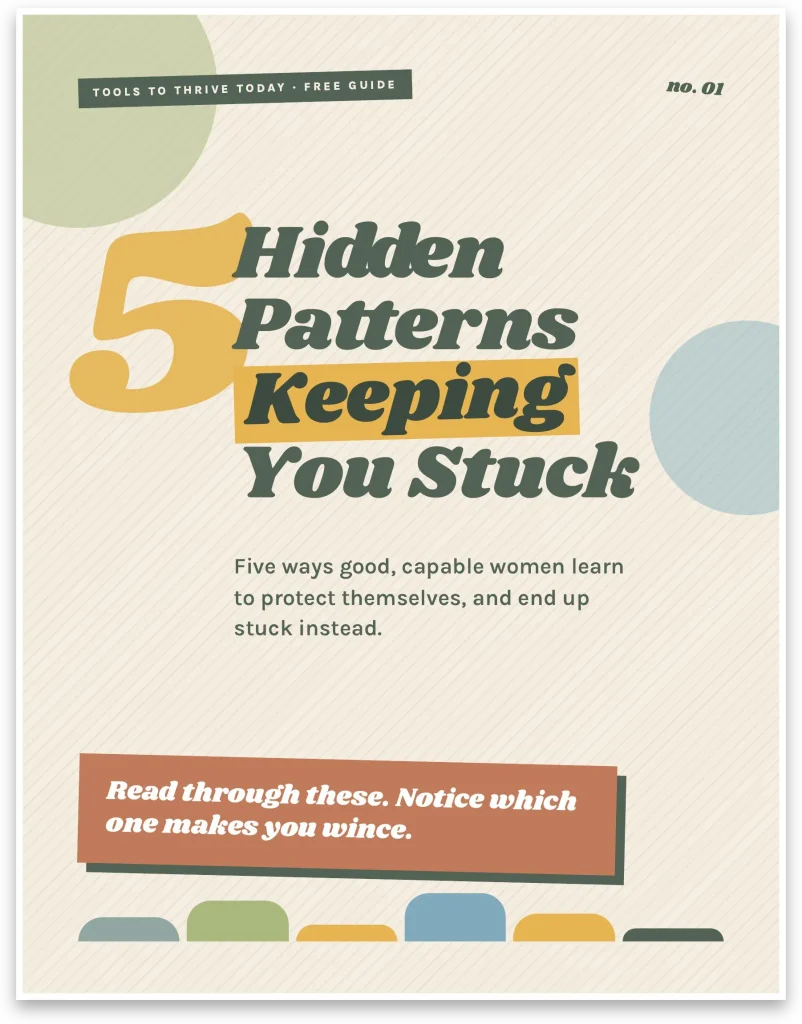
Get the Guide: 5 Hidden Patterns Keeping You Stuck
All five patterns, plus one small move to break each one. Straight to your inbox.
Why They Almost Never Travel Alone
Here's what surprised me most once I started naming these out loud instead of just noticing them in passing. Almost nobody has just one. They travel in pairs, and the pairing tells you something.
Naming it took the shame out of it. It's a lot harder to be embarrassed by a pattern than by a personality flaw. A pattern you can actually change.
People-Pleaser and Rescuer tend to show up together, because they're rooted in the same old belief: that your worth comes from what you do for everyone else. Perfectionist, Doubter, and Waiter tend to show up as a set too, because all three are cousins of the same fear, the fear of being wrong in front of somebody.
If it's the second group that landed for you, you might recognize some of this from when we talked about anxiety feeling like a full-time job a while back. It's the same nervous system, wearing a different outfit.
A clinical breakdown of why the Perfectionist pattern specifically tends to masquerade as high standards, when what's actually underneath it is usually fear, is worth a read if this is the one that got you. Same goes for the psychology behind people-pleasing if that's the pair that stung.
What Happens Once You Can See It
Seeing your pattern isn't a verdict. It's just information, the first honest look at the thing that's been running the show behind the scenes.

If your pattern showed up as the Waiter, waiting for the right sign before you move, this is worth sitting with: there is no perfect time coming. There's just the moment you decide to start anyway.
And if some part of you is waiting for someone to tell you it's okay to stop running the pattern, to rest, to ask for something instead of always supplying it, this is me telling you: permission granted. Not by me. By you. That's the only way it ever actually sticks.
You're Not the Only One Asking
Why do I keep repeating the same pattern even when I can see it clearly?
Seeing a pattern and rewiring it are two different jobs. Insight tells you what's happening. Change happens through small, repeated moments of doing something different, on purpose, especially the moments when the old pattern feels easiest.
Can I have more than one of these patterns at once?
Almost everyone does. Two is the most common combination, usually from the same matched pair described above. Three isn't rare either.
Is this the same thing as a personality trait?
No. A trait is closer to who you are. A pattern is closer to something you learned to do, usually to stay safe in a specific situation a long time ago. That's actually the good news. Learned things can be unlearned.
What's the difference between the Perfectionist and the Doubter?
The Perfectionist stalls before starting or finishing. The Doubter finishes just fine and then can't accept that it was good. They often show up in the same person, at different points in the same project.
Where do I start if more than one pattern feels true?
Start with whichever one made you wince hardest. That's rarely a coincidence.
Come As You Are, Pattern and All
Whichever one landed for you, whichever one made you sit up a little straighter or wince a little harder, that's not who you are. It's just what you learned. And now that you can see it, you get to decide what happens next.
If you want the company of other women doing this same work of noticing, come find us in The Thrive Hive. We're pretty good at seeing each other clearly, patterns and all.
Free Download
Get the Rise & Reset Journal
FreePlus weekly stories, resources, and gentle guidance for life's toughest transitions.
✦ Yes, Send Me the Journal + Weekly SupportUnsubscribe anytime. Your inbox deserves kindness too.