When Your Life Is Already Full, Election Stress Hits Harder: What Helps Before November 3
There is a particular kind of tired that comes from picking up your phone to check the weather and surfacing forty minutes later with cold tea and strong feelings about the opinions of strangers.
If election stress hits harder for you this year because your life is already shifting, you are not imagining it, and what helps ahead of the midterms on November 3 is a written plan for November 4, a daily limit on the news, a few ground rules for talking politics with the people you love, and a short list of what is actually yours to control. I will walk through each one, but first a word about why this kind of stress lands so hard when your life is already full.
Why Election Stress Hits Harder When Your Life Is Already Full
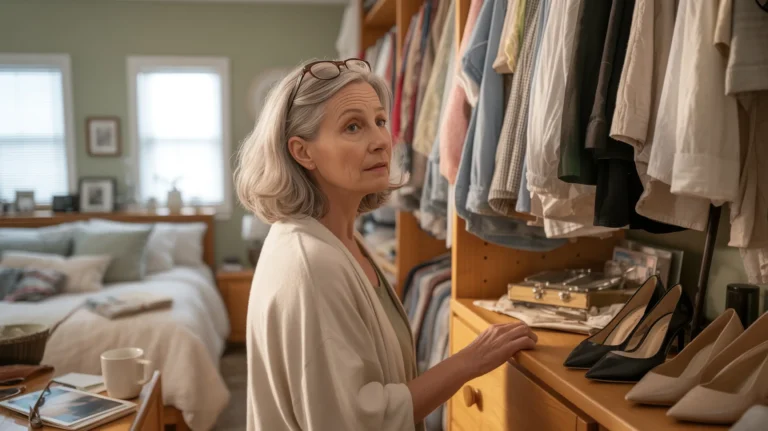
Stress does not arrive in tidy, separate piles. If you are newly divorced, newly retired, newly alone in a house that used to be loud, or newly back in a classroom at an age when you expected to be coasting, your nervous system is already working overtime. Then the news cycle shows up with a fresh batch of worries and finds no spare room, so it lands on top of everything else, like one more coat on a hook that is already holding six.
The numbers back this up. A recent Gallup survey found that roughly three in four Americans (73 percent) have at least a fair amount of concern about more than one aspect of how this year’s elections are run, and the people who spend the most time on social media report the most concern of all. That is not a character flaw. It is a person with a finite amount of room meeting a very full feed, and if you have been following The Overstuffed Life, you will recognize it as the same idea with the stuffing moved into your head.
Write Your November 4 Plan Today
Election stress hits harder when you have no plan for the morning after, so the plan comes first. If I could hand you only one tool before November 3, it would be this: decide now how you want to take care of yourself on November 4, whatever the results look like where you live. My colleague Megan Dwyer, LCSW, founder of Dwyer Method Plus, recommends building a coping plan before the stress peaks instead of trying to invent one in the middle of a hard night, and I could not agree more.
A plan made with a clear head is far kinder than one made at eleven p.m. while refreshing a results page.
Your plan can be as small as you like. Maybe it is a phone call on the afternoon of November 4 with a friend who knows how to listen without fixing, a long walk on your favorite route, or a text to your sister asking her to check in on you once a week through the end of the year. Write it down, tape it somewhere you will see it, and let the paper do the remembering.
If your list of people to call feels shorter than it used to, you are far from the only one, so build the plan around what you do have: the walk, a library book you have been saving, and one small way to be around other humans, even if it is only a standing tea date or an hour in The Thrive Hive. I wrote more about that in Who Gets a Seat at Your Table Now? Living With a Smaller Social Circle.
If you are not sure which part of your life is carrying the most weight right now, our free reflection Where Are You In Your Becoming? can help you name it. It takes eight questions and about two minutes, and there are no wrong answers.

Set Your Limits, Then Spend Your Energy Where It Counts
Limits matter most when election stress hits harder than usual, which it does in a season of change. Start by giving the news a bedtime. Pick a daily limit for the news and for social media, and when your time is up, close the app and do something with your hands. A good sign that you have crossed the line is catching yourself reading the same story for the third time and learning nothing new, which is not staying informed so much as marinating.
Next, set some rules of the game for talking politics with the people you love. Maybe you agree to save the topic until after the election, or to talk about it only in person and keep the text threads for dinner plans and photos of dogs in sweaters. It is perfectly fine to say, “I love you, and I am not discussing this today,” and it is perfectly fine to say it twice. If setting a boundary tends to leave you apologizing for it, The People-Pleaser’s Guide to Disappointing People Gracefully has words you can borrow.
After that comes the part that is actually yours, which is smaller than we would like and more useful than it sounds. Check your voter registration, decide how and when you will vote, and if you have energy left over, give an hour to something you care about, like a food pantry, a library, or a neighbor who needs a ride. Then practice the hardest skill of all, which is letting the rest go. When your thoughts start sprinting, try square breathing: in through your nose for four counts, hold for four, out through your mouth for four, and hold for four, until your shoulders come down from around your ears.

You Do Not Have to Do This Alone
If election stress hits harder when you carry it by yourself, bring it to the Thrive Hive. The election will come and go, and your life will still be sitting right here, waiting for your attention: the new chapter you are building, the old one you are still grieving, the tea that has gone cold again. Be as kind to yourself this month as you would be to a friend who told you she was overwhelmed, because you would never answer her with a lecture.
If election stress hits harder this week than you expected, that is information, not a flaw And, if you would like company for the next two weeks, come find us in The Thrive Hive. We will not be discussing candidates. We will be discussing whether the good cookies live in the pantry or the freezer, and we are very good at both listening and cookies. ☕💚

Election Stress FAQ
Questions we are hearing this week
Why does election stress feel worse when I am already going through a life change?
Stress adds up, and a major change such as a divorce, retirement or empty nest already uses a great deal of your emotional energy. When the election arrives on top of that, there is less room to absorb it, so the same news can feel heavier than it used to. That is a normal response to carrying a lot.
How much news is too much during election season?
There is no magic number, so pick a daily limit that keeps you informed without leaving you frazzled, and stop when time is up. Rereading the same information without learning anything new is a signal that you have had enough, and so is a mood that drops after you scroll.
What should I do on November 4 if I am upset about the results?
Follow the plan you wrote ahead of time: call the friend, take the walk, or ask someone to check in on you that week. Keep your routines, eat something real, and give yourself permission to log off for a day.
How do I talk with family who see things differently without a blowup?
Set the rules before the conversation begins, such as skipping the topic until after the election or only discussing it in person. You are unlikely to change anyone’s mind in a single conversation, so it helps to adjust what you expect from it. You can love someone and still decline the debate.
When is it time to ask for professional help?
If worry is disrupting your sleep, appetite, work or relationships for more than a couple of weeks, or if you feel unable to cope, talk with a licensed therapist or your doctor. If you are in crisis, call or text 988, or text HOME to 741741 to reach a volunteer crisis counselor through Crisis Text Line, any hour of the day. This post is general support and not a substitute for professional care.
Free Download
Get the Rise & Reset Journal
FreePlus weekly stories, resources, and gentle guidance for life's toughest transitions.
✦ Yes, Send Me the Journal + Weekly SupportUnsubscribe anytime. Your inbox deserves kindness too.