
The House That’s Full of Everyone Who Isn’t Here: When It’s Hard to Let Go of a Loved One’s Things
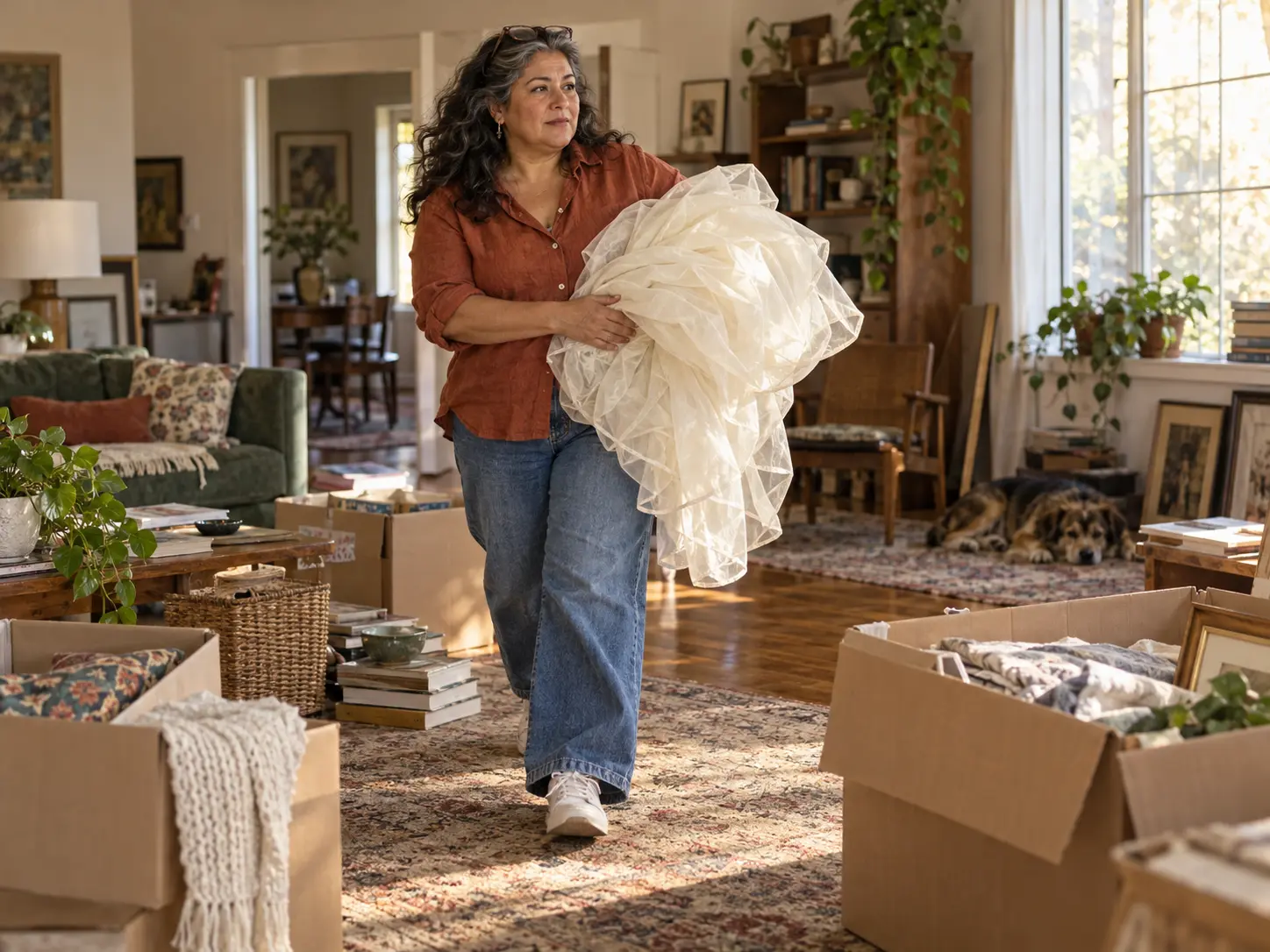
My mother’s wedding dress got pulled out of the pile of things we couldn’t keep so many times that it should have been collecting frequent flyer miles. One of us would carry it off to a safer spot, someone else would haul it back to the pile, and every one of us knew there wasn’t a corner left for it anywhere. If it’s hard to let go of a loved one’s things, there’s a reason, and it has very little to do with being stuck.
Last week I wrote about the echo that settles into a house after everyone goes home, and I haven’t been able to stop thinking about it. I’ve come to believe that some of what we hear in that echo isn’t emptiness at all. It’s company.
This week’s post comes with a video too — because some things are easier to say out loud.
Why It’s Hard to Let Go of a Loved One’s Things
Nothing in my mother’s house was ever only a thing. Every object in it was holding on to somebody, and the home she walked into as a bride in 1945 turned out to be anything but empty. It was full of everyone who wasn’t there anymore, and I think that’s the real reason these things are so hard to release. We aren’t clinging to objects so much as to the people they carry.
Grief researchers have a name for this. Robert Neimeyer, a psychology professor at the University of Memphis who has written extensively about bereavement, describes the cherished items we keep as “linking objects”, and he explains that people find real comfort in them, whether it’s a child’s favorite toy or a husband’s sweater. He also points out that the role of those objects can change over time, shifting from our main way of reaching someone’s memory to a treasured keepsake we carry more lightly. Holding on, in other words, isn’t a sign that you’re doing grief wrong. It can be one of the ways grief does its work.
The Wedding Dress That Wouldn’t Stay in the Pile
My mother had a way of making you feel relaxed and safe, as if you were in on a secret, and she delighted in anything punny. She was eleven weeks short of her hundredth birthday when she passed away in April of 2020. It wasn’t Covid or any one illness. The way I see it, she simply ran out of road.
She spent her winters in Austin with my sisters and came home every spring to my brothers and me and to the house she’d walked into as a bride. In those last years every goodbye carried the question of whether it was the final one, and on the January afternoon she hugged me in my kitchen, I knew in my bones that it was. I was inconsolable.
It was more than a year before the whole family could gather, and the party was exactly the kind she would have loved, full of stories and tears and a great deal of laughter. The next morning we started the impossible job of emptying the house. Mom had taught us to give generously, so her wishes were easy to follow, but once those were taken care of there were too many decisions and way too many memories stuck to way too many things. We invented games and systems for sharing it all out, the lovely things and the “what the heck did she save THIS for” things, and every time we thought we were finished, another trail of treasures turned up.
Then we found her wedding gown. It was the perfect dress for a post-war bride, organza over taffeta with delicate ruffles running down the back, and my parents had waited out the war to begin the life they’d been dreaming about. She treasured it for nearly seventy-five years, and now it was sitting on a pile of things we couldn’t keep. I’m pretty sure each of my sisters and I took a turn at the same little dance, pulling it out and dragging it back, and when it was time for me to head home to my family, I grabbed the dress and ran.
It went into a drawer in an old, unused dresser, and there it stayed. I couldn’t get rid of it and I couldn’t do anything with it either. Around that Christmas an idea arrived: what if I made an ornament from it? It still took another full year before I could bring myself to start, and even then my doubts were loud. Mom made most of our holiday dresses and was a brave, talented seamstress, though she’d have denied it to her last day. My sisters inherited that talent and I decidedly did not.
So I began ridiculously slowly, taking the dress apart by hand. Separating the skirt from the bodice felt brutal, and the sleeves hung there limply as if they were waiting to be set free. I cried at every change, and some days my eyes were so blurry I couldn’t see the stitches. Still, there was something meditative in following those hidden seams and teasing the threads apart, letting her go one piece at a time, and I kept coming back to it because coming back is what she taught me to do.
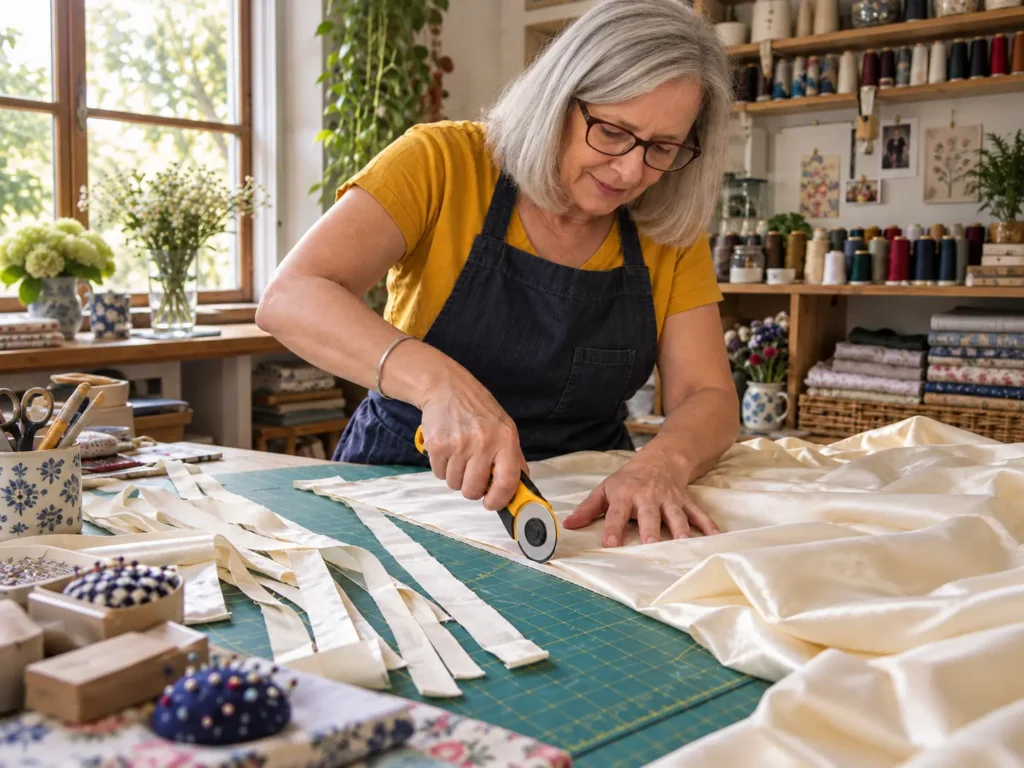
Here’s the part I didn’t see coming. I took a deep breath, made the first cut, and fully expected it to hurt even more. Instead I felt an energy I never knew I had. The blade slid through the layers, and soon there were slim columns of creamy organza and shimmering taffeta stacked in tidy piles, and as I measured and sorted them I felt connected to the young woman who had worn them, wondering what her new world would be like.
That’s when I remembered the endless circle. My siblings and I are the five fingers of our parents’ sheltering hands, so I used bright gold rings to knot clusters of five organza strips between two pieces of taffeta, one knot for each of us, separate and joined in a circle with no end. I made a lot of those ornaments, for my brothers and sisters and for our children, and I made sure the first one was mine. The leftover strips went into clear glass globes, where they look like snow captured mid-fall, and those traveled around to our growing families too.
If you’ve ever stood in a room full of things that belonged to someone who isn’t there and couldn’t tell whether what you felt was grief, or exhaustion, or something that’s been building for years, our free reflection Where Are You In Your Becoming? is a good place to land. It’s eight questions, it takes about two minutes, there are no wrong answers, and it points you toward a few things worth reading next. You don’t have to have it figured out to belong here.
Not Everything Holds Someone
I should be honest that not every object in that house was a relic. Some of it really was just stuff, and the pile of “what the heck did she save THIS for” was real too.
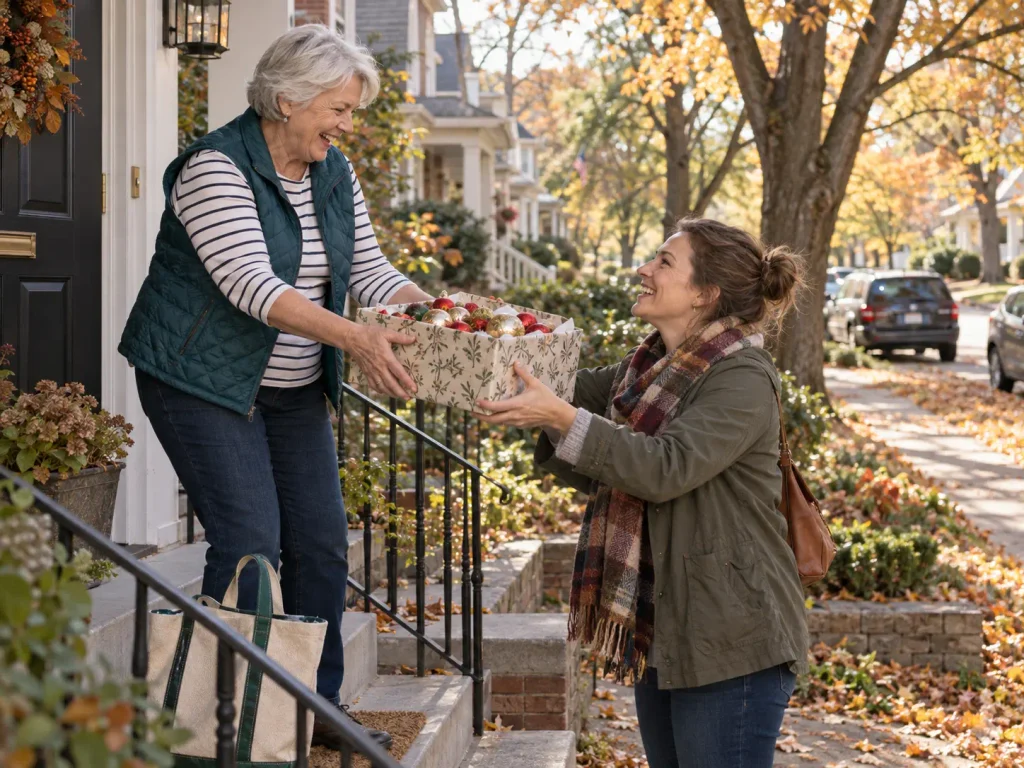
I felt the same split last Christmas when I started winnowing our own holiday decorations. Some of the ornaments were lovely and a few were even valuable, but not to me and not to anyone left in my family. I offered them to my kids first, the way I do with anything that carries real memory, and then people came to pick up what none of us wanted, and they were so grateful. They were happy to give those pieces a new holiday and a new tree and a new home, and I felt lighter watching them go, knowing they weren’t gone so much as loved somewhere else.
Standing between those two piles taught me that the difference was never about how nice something was or what it was worth. It was about whether it was holding someone. The things that held my mother, I kept and carried. The things that were only things got to go find another life, and letting them go didn’t cost me her.
When Your House Never Filled Up the Way You Hoped
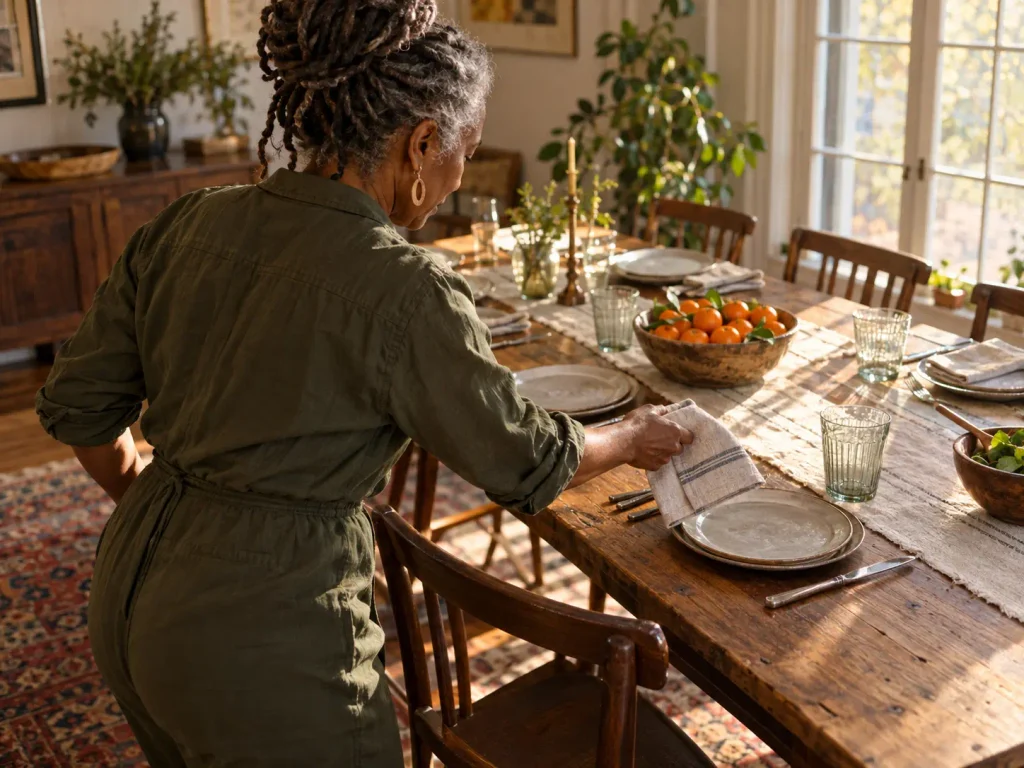
Maybe your house isn’t full of people who have died, or even of people who have moved on. Maybe it never filled up the way you imagined it would. There might be a dining table bought for a family that gathered less often than you planned, a guest room that stays made up for visitors who rarely come, a stack of holiday dishes for a crowd that shrank, or a chair you still pull out for someone who stopped sitting in it years ago. Those things are holding someone too: the people you hoped for, the years you pictured, the version of your life that hasn’t arrived or didn’t stay. If it’s friendships that drifted, this post on the friendships that survive a life overhaul and the ones that don’t might feel like company.
So if there’s a coat on a hook that nobody wears anymore, or a dress folded in a drawer, you don’t have to rush it away or explain it to anyone. They aren’t clutter. They’re proof that you were loved and that you loved someone back.
They aren’t clutter. They’re proof that you were loved and that you loved someone back.
Once we know what our things are holding, we get to ask a better question about the room that’s left, and about who and what we want to let in. We’ll keep walking through that together over the next few weeks, and if you’ve been waiting for permission to even start imagining it, this post about giving yourself permission to start over is a good companion. If you’d like company for the walk, there’s a seat for you in The Thrive Hive, our free Facebook group, where we’re very good at holding each other’s stories and very bad at deciding what to do with the Tupperware lids.
And I’d love to hear from you in the comments. What’s something in your house that’s still holding someone?
Questions That Come Up With a Box in Your Lap
Why is it so hard to let go of a loved one’s things?
Because the things carry the person. Everyday objects and keepsakes hold memories, routines and a sense of someone’s presence, so releasing one can feel like releasing a piece of them. Grief researchers call this a continuing bond, and it’s a common and often comforting part of grieving rather than a sign that something is wrong.
Is it normal to keep a parent’s belongings for years after they die?
Yes. There’s no deadline for sorting or keeping a loved one’s things, and many people hold on to a few meaningful items for the rest of their lives. What matters is that what you keep feels like comfort rather than weight, and if keeping things leaves you feeling stuck or overwhelmed for a long time, a counselor or a grief support group can help.
Does keeping their things mean I’m not moving on?
No. You can keep a sentimental object and move forward at the same time. Many people find that a keepsake changes roles over the years, from something that hurts to touch into a treasured reminder they carry more lightly.
What if I don’t feel anything about most of my loved one’s belongings?
That’s common too. Not every object carries meaning, and something being theirs doesn’t oblige you to keep it. Some things really are just things, and you can let those go while still holding on to the ones that feel like them.
Why does my home feel full of people who aren’t there?
Homes hold the routines, voices and habits of the people who lived in them, so a room can feel crowded with memory even when it’s empty. That sense of presence can be comforting and it can ache, and it’s normal to feel both in the same afternoon.
What if my house never filled up the way I hoped?
Many women grieve a life they pictured rather than one they lost, and that grief is just as real. The things tied to that hope, like a big table or a made-up guest room, are holding something that mattered to you. Noticing what they’re holding is a good first step toward deciding who and what you’d like to welcome in now.
Free Download
Get the Rise & Reset Journal
FreePlus weekly stories, resources, and gentle guidance for life's toughest transitions.
✦ Yes, Send Me the Journal + Weekly SupportUnsubscribe anytime. Your inbox deserves kindness too.


One Comment